
Pillow talk. No doubt these keywords will draw a few extra clicks, as there is more than one interpretation of what they mean.
I remember watching a movie with that title.
We’ll get there in a minute, Lily, but for now you and 9 should probably close your innocent ears.
Ew! That means you’re going to talk about kissing.
Better close your ears quick, 9, or you might hear something icky!
Probably the most commonly known definition of pillow talk is the one that embraces romantic innuendo. From Wikipedia:
“Pillow talk is the relaxed, intimate conversation that can occur between partners after sexual activity usually accompanied by cuddling, caresses, kissing, and other physical intimacy associated with honesty, sexual afterglow, and bonding and is distinguished from dirty talk which sometimes forms part of foreplay and of sexual act.”

Pillow Talk: But we’re not talking about couch pillows this time. . .
Okay, girls, you can open your ears now. The second way I’ll examine pillow talk does, in fact, have to do with the movie Lily mentioned. The script, as I recall, doesn’t have the racy language that Wikipedia employs, because, hey, the movie came out in 1959! However, even a kid could comprehend that Pillow Talk, a romantic comedy starring Doris Day, Rock Hudson, and Tony Randall, was loaded with racy innuendos. . .Once more from Wikipedia:
“It tells the story of Jan Morrow (Day), an interior decorator, and Brad Allen (Hudson), a womanizing composer and bachelor, who share a telephone party line. When she unsuccessfully files a complaint against him for constantly using the line to woo his conquests, Brad finds out she is pretty and decides to trick her by masquerading as a Texas rancher. The scheme seems to work until their mutual friend Jonathan Forbes (Randall) finds out about it and exposes Brad.”
The film is noted for a brief split screen scene in which Day and Hudson flirt with each other over the telephone while soaking in separate bathtubs in their own apartments. It was a workaround for a film production code at that time which limited the contact actors could have on screen in heated romantic situations.
Barf on the “R” word!
Thank you for the color commentary, 9.
The kind of pillow talk that interests me today has more to do with getting a good night’s sleep: I’m talking about talk about pillows. Through a diligent three or four nights of experimentation I’ve concluded that getting a new pillow might help!
Several days ago I noticed my fiberfill pillow was flat, and sagged in the middle.

Pillow Talk: Newly selected sleep pillow, L, v. former sleep pillow that is now a sham pillow, R.
It was no longer a comfortable cradle for my head and neck. I’d read somewhere that pillows need to be replaced every “x” number of months for optimal sleep but had disregarded this information. It came from an entity that sold pillows, so naturally I viewed the claim with consumer skepticism.
However, the last time I changed the bed linens I realized the sham pillows were significantly plumper than the one I’d been using for a sleep pillow “x” number of years. So I did a switcheroo.
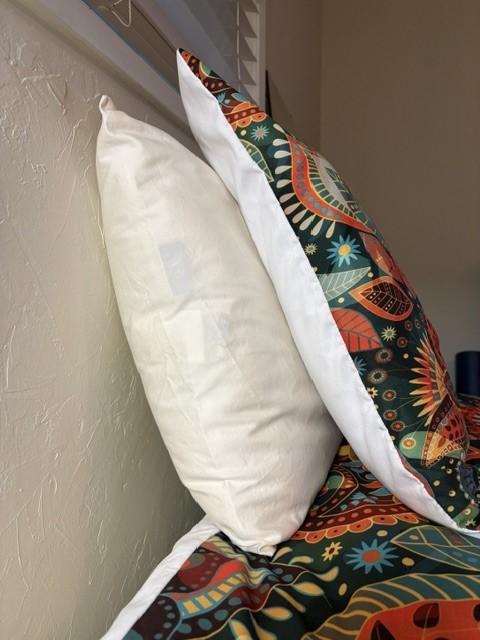
Pillow Talk: The happy result of a bit of thought and analysis. . .
Wow, what a difference!
From a company that sells sleep apps https://www.calm.com/blog/how-often-should-you-replace-your-pillow, here’s a breakdown of the benefits of switching to a new (or, in my case, a less-used) pillow:
“1. It keeps your spine aligned: When a pillow flattens out or loses shape, your head and neck can sink into awkward angles. Over time, this can mean morning stiffness, tension headaches, or a general feeling of unrest. A supportive pillow helps keep your body in better alignment, so you’re less likely to wake up sore.
2. It reduces allergen exposure: Even with regular washing, pillows accumulate dust mites, skin cells, sweat, and sometimes mold. For people with allergies or asthma, this can mean nighttime congestion or itchy eyes. Replacing your pillow reduces that buildup and makes the air around your face cleaner.
3. It improves overall hygiene: Pillowcases help, but they can’t block everything. Over time, oils and bacteria seep into the pillow itself, leaving behind stains, odors, and a less-than-fresh feeling. A new pillow simply feels cleaner, and that freshness can make bedtime a lot more inviting.
4.It supports deeper, more restful sleep: When your pillow works with you instead of against you, you’re less likely to toss and turn. This consistency can then help you fall asleep faster and give you the uninterrupted rest your body needs.”
As someone who struggles to sleep more than six hours a night, I’ve tried several tweaks to improve my sleep. Swapping out pillows has been one of the simplest and most effective hacks for me.
Simply put, pillow talk has evolved into pillow action!