
Last week was jam-packed with modeling! If you envision someone less than twenty years old strutting down a runway in jaw-dropping cutting-edge attire, permit me to redirect you.
So what are you talking about, exactly?
I’m talking about two things, Lily. The first thing happened last Thursday. I was in a brief photo session at Kirkman House Museum. The collections manager recruited me to model for a photo for their first exhibit of the season, Aprons through the Ages.
The promo for that event isn’t out yet so I can’t share the official picture, but we’re in luck! Remember the blog we did a while back, Cleaning Like June Cleaver? Here’s a representative photo from that post:
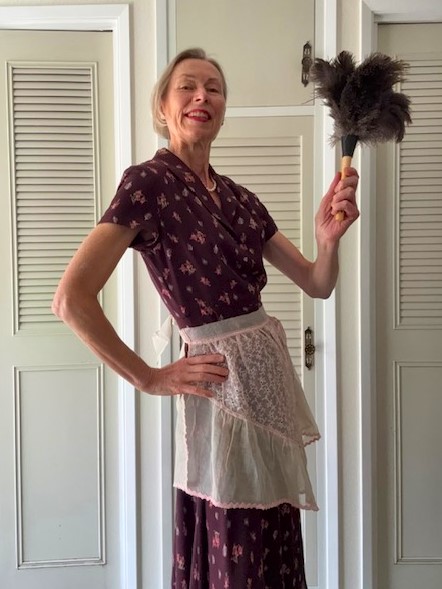
One type of modeling: “Aprons through the Ages” a la June Cleaver.
You can revisit that particular blog here:
https://www.susandmatley.com/official-blog/cleaning-like-june-cleaver-with-the-people-inside/
You look kind of scary! Are you sure people will want to come to the museum?
Don’t worry, 9, only the outfit is the same. In the promo photo I am well-behaved, demurely pouring a cup of tea.
That was Thursday’s modeling adventure. Friday brought something quite different, starting with a 6 AM flight from Walla Walla to Seattle to attend something called a Physical Model Witness Test.
I am unacquainted with that string of words.
So was I, Lily. But I knew what I was there for: to see a scale model of an engineering design in operation. It’s part of the Mill Creek fish passageway project here in Walla Walla. When town was built in the mid-19th century it was located along Mill Creek. Very sensible, considering many people hauled their domestic water in those days, but eventually problems occurred. A disastrous flood in March, 1931, destroyed homes, businesses, roads and bridges. This eventually led to the construction of the Mill Creek Channel and Bennington Lake (a reservoir with a dam system) to control future flooding. A brief history, with photos, is available here:
https://www.wwcowa.gov/government/public_works/flood_control.php
There have been subsequent major floods, most recently February 7, 2020. I happened to be out and about that day, coming home from Spanish 121 at Walla Walla Community College. With the aid of my trusty digital camera I caught this and other images:

Colville Street in Walla Walla, beautifully modeling the February 7, 2020 flood. . .
Taking this and other pictures on that wild day was the start of my involvement with Mill Creek. Since then, I’ve done a bit of administrative and field assistance support for one of the engineering firms involved. Definitely an interesting diversion from my usual pursuits!
A major focus of the channel is, necessarily, flood control. In this century another concern is being addressed: the need to enhance fish passage for local species that are challenged by dangerously high cfs (cubic feet per second) flows, seasonal variations in water temperature (too warm), and other issues.
The channel is nearly 7 miles long. Some portions of it are concrete-lined, including the underground section that cuts through downtown Walla Walla.
Wait! The channel goes under the city?
That is correct, Lily. A portion of that section, incorporating the conditions proposed in the new design, is replicated in the scale model I saw on Friday.
See the light-colored arc in the parking lot pictured below? That’s the area the model covers. Note the high curve.

The area being modeled is under the arc highlighted on this downtown Walla Walla parking lot.
The next photo shows the entrance of this section, unpaved, in the 1960s.

What lies beneath: A picture of the triple channel c. 1969, before it was covered.
The model incorporates design features (weirs, panels, resting pools, etc.) to improve fish passage. The test involved flows varying from 92 cfs to 4500 cfs, to see how design modifications would affect such things as super critical flows (where the water velocity exceeds the wave propagation speed).

The model itself: At high flows, 4 to 5 inch waves (scale 1:12 = 4 to 5 foot waves) are created at the entrance to the triple channel. . .
This is a lot of information to absorb.
I agree, Lily. It’s a whole different language when the engineers brainstorm about mitigating whatever issues a model can reveal. I find their conversations oddly fascinating!
Great, now you’re an engineering groupie.
Forward I go in life, gathering new and exotic experiences. Modeling with aprons and teapots is one thing; modeling solutions for a fish passageway is quite another!

Fascinating info about underground Mill Creek! You live such an interesting life.
It’s really quite a project, and so fun for me to look at the world from an angle so different from my day-to-day!